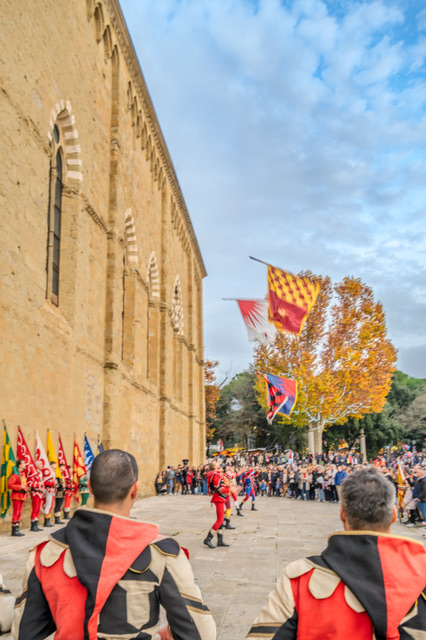
Perched on the Tuscan hills, Arezzo is a city where Etruscan roots, medieval streets and Renaissance art quietly flow into everyday life. This visual report captures its stone piazzas, hidden churches, craft shops and slow food moments that give the city its intimate, lived-in charm. From mid-November to early January, Arezzo transforms into Arezzo Città del Natale, wrapping its historic centre in lights, markets and festive installations that turn the city into a Christmas village.
Being a musician myself, Arezzo has an important place in history for all western music, as it is the city where Guido d’Arezzo (in Arezzo called monk Guido) in the 11th century created the basis of modern staff notation – especially:
- the use of lines and spaces to fix exact pitches (his four-line staff), and
- the solmization system that became do–re–mi–fa–sol–la.
Together, these made it possible to read and teach music quickly and accurately, instead of relying mainly on memory. Everything from classical scores to pop sheet music today grows out of Guido’s ideas, so he’s often called the “father of modern music notation.”
Culinary heritage of Arezzo
Set in the eastern hills of Tuscany, Arezzo’s culinary heritage is deeply rooted in its farmland, vineyards and centuries-old peasant traditions. Here, food is still very much “from the land”: hearty soups like ribollita and acquacotta, made with cavolo nero, cannellini beans and stale bread, sit alongside dishes that honour Chianina beef, game, mushrooms and seasonal vegetables.
In and around Arezzo, cooks make the most of simple, local ingredients – farro, chickpeas, pecorino, olive oil and robust red wines – turning them into soulful, home-style recipes that haven’t lost their Etruscan and medieval echoes. Street markets, village sagre and family-run trattorie keep these flavours alive, offering visitors a taste of everyday Tuscany that is authentic, generous and quietly unforgettable.
Two pastas are especially typical for the Arezzo area:
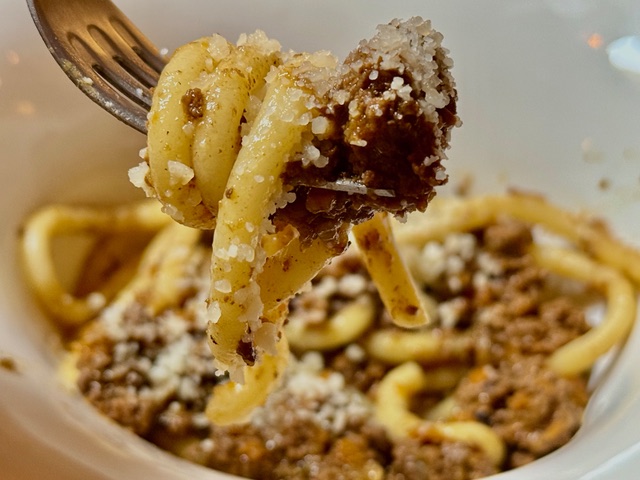
- Maccheroni Aretini
- Fresh, wide ribbon pasta, very similar to tagliatelle.
- Traditionally served with a rich goose ragù (maccheroni co’ l’ocio), a classic of the Arezzo countryside.
- Bringoli (or Bringoli Aretini)
- Hand-rolled, thick spaghetti-like strands, closely related to Tuscan pici.
- Typical around Anghiari / Arezzo, often dressed very simply with good olive oil and pecorino, tomato sauce, or game ragù like wild boar.
So if you want to eat “like Arezzo,” look for maccheroni aretini with goose sauce or a plate of bringoli/pici with a rustic local ragù.
A visual report of a single day visit in this historic town in Tuscany.